Exploring the Legacy of Hal Puthoff: A Pioneer in Quantum Physics and Parapsychology
Explore Hal Puthoff's contributions to quantum physics and parapsychology, highlighting his impact on remote viewing and zero-point energy.
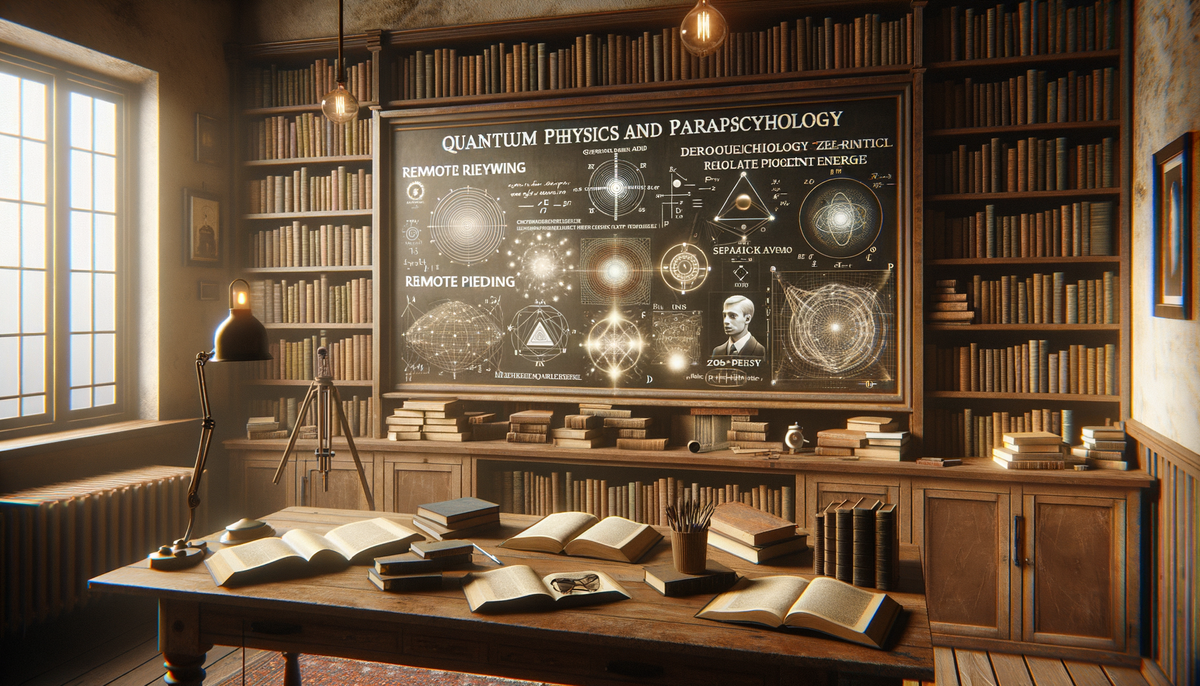
Exploring the Legacy of Hal Puthoff: A Pioneer in Quantum Physics and Parapsychology
In the world of scientific exploration, few names are as intriguing and multifaceted as Hal Puthoff. Known for his bold ventures into the realms of quantum physics and parapsychology, Hal Puthoff has cemented his legacy as a pioneer. In this week's exploration of trending news in the Hal Puthoff space, we aim to delve into his contributions and influence that span over four decades across various scientific disciplines.
Academic Excellence and Early Career
Hal Puthoff's journey into the world of science began with an unwavering dedication to academia. He graduated with a Bachelor of Electrical Engineering and a Master of Science in Engineering from the University of Florida, Gainesville. His commitment to electric engineering propelled him to earn a Ph.D. from Stanford University in 1967, completing a pivotal thesis titled "The Stimulated Raman Effect and its Application as a Tunable Laser," under the mentorship of Richard H. Pantell.
Stephen Baxter Laser Physics and Quantum Electronics
Much of Puthoff's early career was dedicated to the field of laser physics and quantum electronics. During this period, he made significant strides in developing tunable lasers and electron beam devices, with one of his notable achievements being the development of a tunable Raman laser capable of producing high-power radiation across the infrared spectrum. This breakthrough not only marked a milestone in laser technology but also broadened the horizons of optical research.
Parapsychology and Remote Viewing
In 1972, Puthoff expanded his scientific inquiries into the realm of parapsychology by joining the Stanford Research Institute (SRI). In collaboration with Russell Targ, the duo spearheaded remote viewing research—an experimental method for investigating extrasensory perception (ESP). Their pioneering work led to the successful publication of "Mind Reach" in 1977, and while it garnered interest and skepticism alike, it contributed significantly to the discourse on human potential and perception.
Puthoff also ventured into other areas of paranormal research, collaborating with Uri Geller, an Israeli psychic renowned for his alleged psychokinetic abilities, and Ingo Swann, a claimed remote viewer.
Theories on Zero-Point Energy and Later Work
In his later endeavors, Puthoff delved into theoretical physics with a particular focus on zero-point energy. His studies on frontier physics exemplify his quest to understand unexplained phenomena through a scientific lens. This thirst for knowledge places him uniquely at the intersection of conventional scientific inquiry and speculative exploration.
Actionable Insights for Professionals
For professionals in the realm of quantum physics and parapsychology, Hal Puthoff's career offers several takeaways. His work emphasizes the importance of interdisciplinary collaboration, as seen in his joint efforts with prominent researchers across diverse fields. Moreover, Puthoff's achievements underscore the necessity of open-mindedness and innovation in tackling unexplained phenomena.
Our Expertise and Call to Action
At Newsomix, we recognize the complexities and the potentialities of such groundbreaking research. We invite you to explore our deep dives into current explorations within the Hal Puthoff space. With expertise in AI consulting and other cutting-edge technologies, we are poised to aid businesses ready to engage with the next frontier of scientific exploration.
Call to Action: For those intrigued by these realms of inquiry, we encourage a consultation to see how our services can fortify your scientific endeavors.